
I · THE LANDSCAPE
AI's economic footprint is measured today in fragments.
Each of these efforts is valuable. None can be compared with the others, and none links usage to wages, hiring or firm output.
PUBLISHED MEASURES TODAY
WHAT NONE OF THEM PROVIDES
- 1A common task taxonomy across providers
- 2Comparable measures of depth of use and output
- 3A link from AI use to wages, hiring and firm output
Baseline is built to connect them.
~0.7%
added productivity over ten years (Acemoglu, 2024)
7%
added global GDP (Goldman Sachs, 2023)
Scope. External estimates, not Baseline measurements. Productivity and GDP are different measures; this graphic illustrates disagreement, not a harmonized comparison.
Acemoglu, "The Simple Macroeconomics of AI," NBER w32487 (2024). Goldman Sachs, "Generative AI could raise global GDP by 7%" (2023).
Forecasts of AI's contribution to the economy disagree by an order of magnitude. The labor-market evidence is mostly nulls and mixed results.
Why comparable data matters
The disagreement is not a failure of economics. It is a failure of data. No company can publish a comparable index with its competitors, and public institutions cannot see provider data. So investment, hiring and policy decisions rest on assumed parameters.
Baseline replaces assumed parameters with measured ones.
III · ROADMAP
Measure first. Then estimate. Then simulate.
THE SCENARIO TRACKER
Which AI scenario are we in? Every quarter, the data will say.
External scenarios · Tracker planned. The figures below are cited scenarios, not observed Baseline results.
MODEST
+1.6%
GDP by 2030. Unemployment up a tenth of a point.
SUBSTANTIAL
+8.3%
GDP by 2030. Cognitive employment down about 4%.
EXTREME
+32%
GDP by 2030. Nearly one in five cognitive workers unemployed.
Four parameters: task share, adoption, productivity, and automation versus augmentation.
How the scenario tracker works
Each scenario rests on a handful of measurable parameters: the share of tasks AI performs, how widely it is adopted, the productivity gain per task, and how much work is automated rather than augmented. Today, none of the three can be ruled out. Baseline measures those parameters across providers and publishes, every quarter, where the evidence points.
Scenarios from Korinek, Jones, Sacher, Cotter and McCrory, "Economic Scenarios for Transformative AI," The Anthropic Institute Working Paper 2026-02. Explore the scenarios
Your data stays yours.
Raw data never leaves its owner. Each provider runs agreed queries on its own systems, and only aggregates are shared. Analysis plans are registered before any data is opened, and an independent steering committee sets methodology and decides releases.
Baseline is forming its founding group of AI providers, data platforms and economists.
WHO IT SERVES
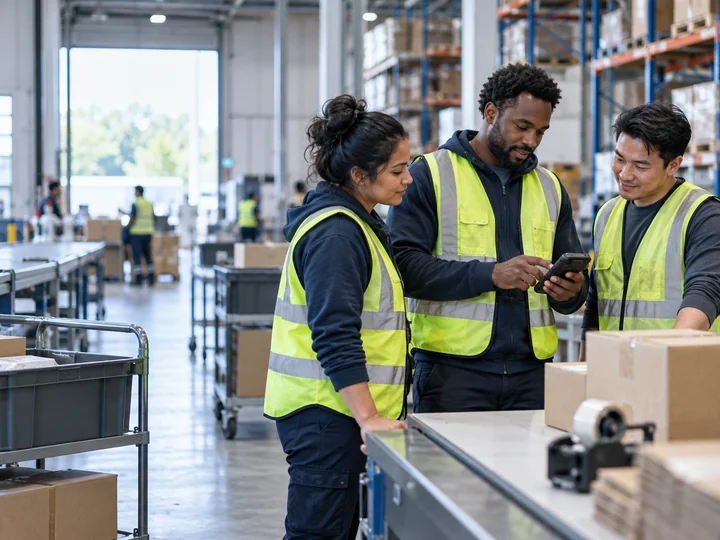
Behind every data point is a person's work.


IV · WORKING GROUPS
Six working groups build the measurement stack, from task to world model.
Each group pairs provider engineers with independent economists and publishes its specifications openly. Together they produce the measured parameters an AI economy world model needs.
Swipe or use arrow keys to explore the working groups.
PHASE 1
Measure
Task ontology
A versioned crosswalk from provider logs to O*NET tasks, extended to multi-step and agentic work.
Delivers the Baseline Task Taxonomy and an open classifier.
Output and verification
Quality-adjusted output: cost per verified task, depth of use, and a price deflator for AI-produced work.
Delivers the output-unit specification and verification protocols.
Privacy-preserving aggregation
Federated queries, minimum cell sizes and differential privacy, so only safe aggregates leave each provider.
Delivers the query protocol and disclosure-review rules.
PHASE 2
Estimate
Causal identification
Linking AI use to wages, hiring and firm output, using staggered rollouts, price changes and outages as natural experiments.
Delivers pre-registered study designs and linked research panels.
Compute production functions
How compute converts to output by sector: elasticities, substitution between labor and compute, and energy and capacity limits.
Delivers sector-level elasticity estimates with stated uncertainty.
PHASE 3
Simulate
The AI economy world model
How the world model is built
An open, calibrated simulation of the AI economy that combines agent-based and general-equilibrium models and runs across adoption regimes, from augmentation to autonomous agents. Every parameter traces to an estimate from Phases 1 and 2.
Delivers a quarterly scenario tracker from 2027, then the open model and a public scenario library in 2028.
Governance and independence sit with the steering committee, across all six groups.
V · QUESTIONS
What partners and policymakers ask first.
Is sharing usage data between competitors an antitrust risk?
Only aggregates leave each provider, through a neutral host, under clean-team rules. No pricing, capacity or customer-level data is exchanged, and antitrust counsel reviews the protocol before Phase 1 begins.
How is Baseline different from existing usage indices?
The Anthropic Economic Index, OpenAI's ChatGPT study, Microsoft's diffusion reports and Google's ATLAS each describe one provider. Payroll studies link AI exposure to jobs, but not to measured usage. Baseline makes usage comparable across providers and links it to outcomes.
Can linked data identify causal effects?
Phase 2 relies on variation firms do not choose: staggered rollouts, price and rate-limit changes, outages and model releases. Analysis plans are registered before any data opens.
How is privacy protected?
Raw data never leaves its owner. Providers run agreed queries on their own systems, and results are released only above minimum cell sizes, with differential-privacy protections and disclosure review.
VI · GET INVOLVED
Membership is by invitation.
Baseline brings together a small founding group to define the shared standard. Tell us where you fit.
PUBLICATIONS
Everything we publish, in the open.
 BASELINE BRIEFING PAPER NO. 1Measuring the AI Economy
Reference this briefing
Baseline. Measuring the AI Economy. Baseline Briefing Paper No. 1, October 2026. Version 1.0. https://www.baselineindex.org/baseline-briefing.pdf
National income accounts gave the twentieth century a shared picture of its economy, and with it the ability to steer. Baseline aims to do the same for AI: a standing, public record of what AI produces and for whom, so its gains are visible early, measured honestly and broadly shared.